My study workflow
How I study law with AI
I start with the assigned reading and my class notes. Then I use AI to turn the same material into something I can listen to, picture, or test myself on.
Take agency. I can read the elements in an outline, spot them in a story, then close the notes and try a new fact pattern. Each pass asks me to do something different.
Use Next to tour the tools and try the examples.
Speechify
Make the reading listenable
I prepared a Speechify guide for Functions of the Prosecutor and listening copies for Evidence. A page that looks clear on paper can sound confusing when a reader speaks every abbreviation and page header.
On the page FRE 401(a)–(b)
In a listening guide Rule four oh one. Ask two questions. Could this evidence change how likely a fact seems? Does that fact matter to the case?
I keep the rule number in the script so I can find the original wording after listening.
Outline summaries
Shrink a chapter to a prompt
In my Evidence review, a paragraph on relevance became a short sequence I could reconstruct from memory. Open the outline to see what survived the cut.
A delivery slip shows when a parcel arrived. The time matters only if something in the dispute turns on timely delivery.
Show the outline version
- Identify the evidence — the dated slip.
- Explain the inference — the parcel arrived that day.
- Connect it to a fact that matters — whether delivery met the deadline.
Fairy-tale summaries
Counsel of the Fairy Court
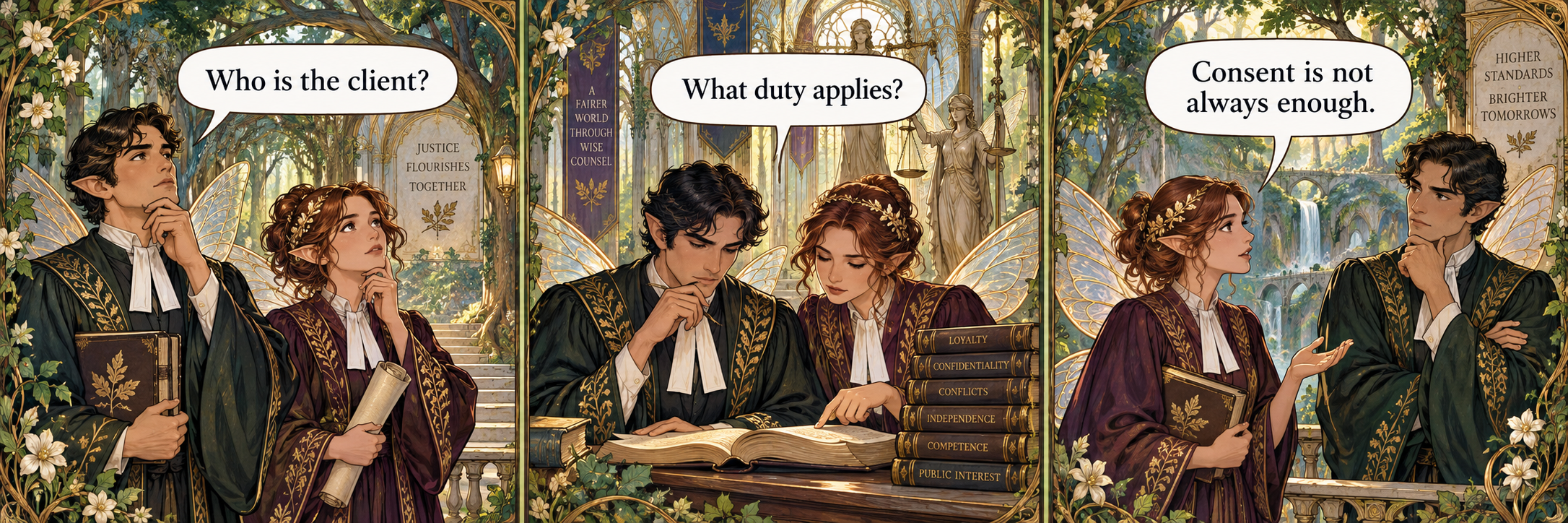
In my Professional Responsibility room, the court is a fairy court, but the lawyer still has a client. A character gives me a way to remember whose interests are at stake.
A new Fairy Court vignette
The royal treasurer pays the advocate to represent a glassblower. At supper, the treasurer asks what the glassblower said in private.
Whose confidence is it?
The glassblower is the client. Paying the bill does not itself entitle the treasurer to the conversation. That distinction gives me a way back to the confidentiality rule.
Self-grading practice
Change one fact. Try the quiz.
A florist asks Rowan to buy twelve white roses on her behalf. Rowan agrees. The florist can change the order before purchase. Which detail most directly illustrates the florist’s right of control?
Try the full agency lesson and quiz
Evidence flowchart
Follow one piece of evidence
The Evidence admission flowchart lets me work through a problem one decision at a time. Here’s a short example of the first fork.
A shopkeeper heard the fire alarm and left the building.Why offer the sound of the alarm?
To explain why the shopkeeper left
The sound helps explain the listener’s reaction even if there was no fire. Follow that purpose through the remaining admissibility questions.
To establish that there was a fire
Now the alarm’s accuracy matters. Ask how it was triggered and what the witness actually knows.
Open the Evidence admission flowchart
Audio review
Rehearse an objection aloud
My Evidence midterm audio review covered classes one through nineteen. This short reading comes from the part that walks me through an item of evidence.
Read the excerpt
For each item of evidence, answer six questions. What exactly is being offered? Who offers it, and through which witness? What fact of consequence does it help prove? What inference connects those two things? Which special rule applies? What should the judge do, including redaction and a limiting instruction?
Study songs
Put the test in a chorus
My Business Associations soundtrack includes “Consent,” “That Veil Is Coming Down,” and “Three Fiduciary Duties.” I use a chorus to remember the questions, then apply them to facts.
A new agency refrain for this tourWho agreed? Who acts for whom? Who has control?
Three questions for the room.
Browse the study soundtracks
Inside the collection
Choose a way to practice
- Doctrinal study rooms pair case briefs and illustrated explanations with short problems. Evidence uses noir case files. Property uses noble estates.
- The MPRE Companion turns ethics review into short lessons, courtroom comics, recall cards, and listening notes.
- Immigration Law includes a courtroom tour and a simulator with a debrief.
- Kansas Law includes a guided issue spotter and a sentencing worksheet.
For a first visit, the free agency lesson puts the explanation, visual, and quiz together. Some collections require a passcode.